The Recipe That Changed Along the Road
Trace how a recipe changed along the road by comparing ingredients, methods and the people who carry it, without forcing its versions into one origin story.
The common mistake with a recipe that changed along the road is to treat the earliest written version as the only authentic one. That can erase the cooks who adapted it for a new kitchen and leave a neat origin story that does not explain the dish people make today.
A recipe travels with people, then meets a different larder, stove and routine. To understand what changed, compare the food itself and the settings in which people make it. Keep the focus on the cooks’ choices rather than trying to crown one version as the original.
Set a clear question
Choose what you want to understand: how a dish reached a neighbourhood, why its filling changed, or what local cooks consider essential now. The question shapes what to compare.
- If you are tracing movement: note the places and family, work or trading connections named in accounts. If those links are specific, describe them; if they are absent, focus on the dish’s present-day similarities.
- If you are comparing ingredients: list each version’s ingredients and preparation separately. If the filling differs but the dough is alike, describe both facts; if the ingredients are too vague to compare, ask a cook for a more precise description.
- If you are describing current custom: ask local cooks what they call the dish, when they make it and what they regard as essential. If answers vary, describe the different practices rather than selecting one as the standard.
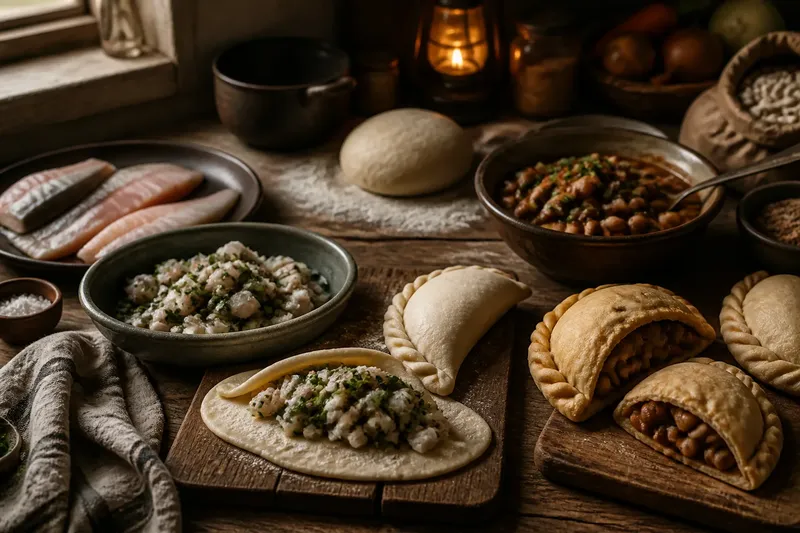
Say you are comparing stuffed pastries in a port town and an inland village. Your starting notes list fish in the port filling and beans inland, with no record of how the recipes travelled. Ask cooks what the fillings mean to them, then describe the difference and the shared pastry form; the result is a useful comparison without an invented route.
Read the local larder
Ingredients can point to the conditions in which a version is made. A coastal cook might use fresh fish, while an inland household uses pulses, preserved vegetables or dried fish. Supply, storage, season, cost and preference can all shape that choice; do not assign a cause unless a cook or account gives you one.
Look beyond the filling. A dough, vessel or folding method may stay familiar as ingredients shift. Or the filling may persist while cooks change the cooking method to suit a hearth, oven or communal kitchen. Record each part separately so the adaptation remains visible.
Ask, “What goes into yours?” and “What makes it feel like this dish?” These questions invite cooks to describe their own choices without requiring them to defend a single correct version.
Compare sources and settings
A handwritten family recipe records what one household wrote down, not necessarily when a dish first arrived. A restaurant menu can show how it was served in that setting, while an oral account may explain family memory or local meaning. Treat each source as a different view of the dish.
Note who shared an account, where they learned the recipe, and whether they mean a family habit, a shop version or a community custom. If accounts differ, keep them distinct. Place names matter too: a market name and a name used at home may refer to different preparations, or different preparations may share a name.
For a public display or menu note, describe the local version first, then add a comparison if it helps the reader understand the dish. Distinguish a documented connection from a resemblance; the point is to make the food legible, not to force a single family tree.
What should you compare?
How do I compare two recipes?
Record ingredients, technique, name and occasion for each version, then mark what matches and what differs. Ask who makes each one and where they learned it before describing any connection.
Can a substitute become part of a tradition?
Yes: cooks may keep using a substitute and pass the practice on. Describe who uses it and in what setting, rather than treating “traditional” as a claim that the recipe never changed.
What if cooks describe different origins?
Present each account with its setting and speaker’s connection to the dish. You can then explain what the versions share and where their details diverge.
Should I use the word authentic?
Use it only when you name whose standard you mean, such as a household’s own recipe or an association’s stated practice. For several established forms, naming the place and preparation is often clearer.
Describe the changing dish
Connect a change to a particular setting or choice: an ingredient used in one kitchen, a method suited to its equipment, or a flavour a cook prefers. Not every difference needs a dramatic journey behind it; one cook may simply favour a sharper sauce.
When writing about the recipe that changed along the road, name each version and give its makers room to explain what matters to them. A useful final detail is where a cook learned the version they make now; that answer can show how the dish continues to move through households and kitchens.