What “Local” Means on a Food Label
Read a local food label with confidence by distinguishing where a product was made, where its ingredients grew and what its claims actually cover.
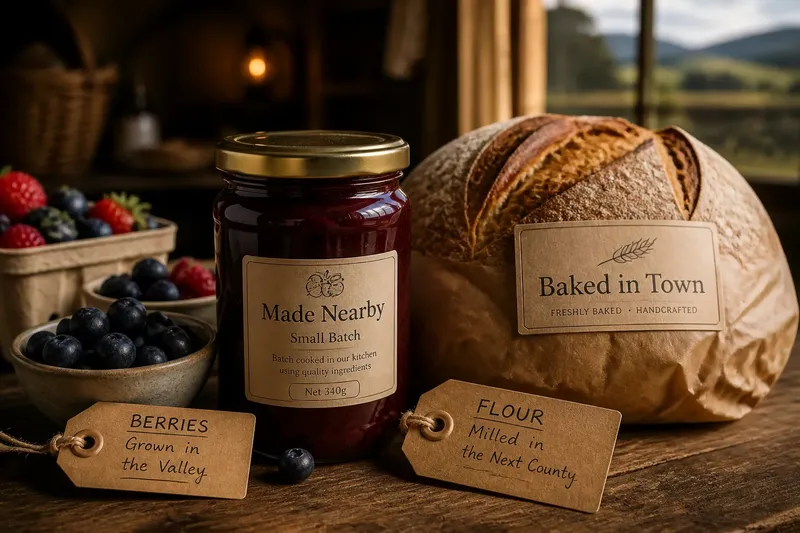
The common mistake with a local food label is assuming it tells you where every ingredient came from. That can lead you to choose a jar made nearby while believing its fruit was grown there too. Read the exact claim and decide whether it matches the connection you want to support.
A loaf baked in town may use flour milled elsewhere; a jar of jam made nearby may contain fruit from another region. Those details do not make either product better or worse. They tell you what the label can—and cannot—help you decide.
Read the wording
Find the specific phrase attached to “local”. It might describe a farm, a maker, a processing site or a packing location. A nearby business address alone does not identify where the food was produced.
- “Made here” points to preparation or processing. If the maker bakes bread there, the baking is local; the phrase does not establish where the flour grew.
- “Grown locally” describes the crop’s growing place. It does not say where the crop was milled, cooked or packed.
- “Sourced from local farms” suggests a connection to producers, but may not name the farms or the ingredients involved.
- “Packed locally” identifies a packing place. It does not, by itself, identify where the food was grown or made.
Read the words around the claim, including the ingredient list and any detail about production. If the wording names only a place, check whether it says what happened there.
Separate the stages
For a useful comparison, distinguish three things: where the food was made, where its ingredients came from and where it was packed or sold. These are separate links in a product’s journey, even when one business handles more than one.
“Made” can mean baking, pressing, churning, curing or cooking. A maker may carry out that work locally using ingredients brought in from elsewhere. Ingredient origins can also vary within one product: chutney might use nearby apples and onions but vinegar and spices from outside the area.
A local shop or packing site is another kind of connection. It may be meaningful to you, but it should not stand in for a claim about growing or production.
Write down the stage the label actually identifies before comparing products.
Define the area
“Local” has no single everyday boundary that applies in every place. A producer may mean a neighbouring district, a wider region or a supply area. Ask what area the claim refers to if the boundary affects your choice.
Keep the question focused. “Where was this made?” is easier to answer than “Is it really local?” If the reply names a town, ask which part of the product is made there. For a crop, ask where it was grown rather than assuming a regional label covers every ingredient.
Say you are considering a jar of berry jam labelled “made nearby”. You want fruit grown in the area, so you ask whether the berries come from local growers or a wholesaler elsewhere. If the maker says the berries are bought from outside the area, you can still describe the jam as locally made, but not as made with local berries. If the maker cannot identify the source, that part remains unspecified.
Choose by connection
Decide which local link matters for this purchase. You may want to support a nearby maker, buy ingredients grown in a particular landscape or find a regional product made there. One claim does not answer all three questions.
Locality alone also does not tell you about seasonality, farming methods, transport, availability or suitability for your household. Treat those as separate considerations rather than reading them into the word “local”.
- If the label names a nearby production site, check what work happens there; if it only gives a business address, treat production location as unconfirmed.
- If a product says “grown locally”, check which crop or ingredient the claim covers; if it names only one, do not extend the claim to the rest.
- If the label names farms, check whether it links them to a specific ingredient; if it does not, treat the farm connection as general rather than product-specific.
- If the wording says “packed locally”, check for a separate growing or making claim; if none appears, regard packing as the only stated local stage.
- If the product has several ingredients, check whether the origin information names each one or only some; if only some are identified, keep the others unspecified.
- If a stall sign uses “local” without naming an area, check what boundary the seller means; if the reply remains broad, decide whether that level of detail is enough for your purchase.
Questions about labels?
Does locally made mean locally grown?
No. The phrase generally describes where a product is prepared or processed, not where its ingredients were grown. Check the wording for a separate growing claim.
Does local packing make food local?
It identifies where the product was packed, not necessarily where it was grown or made. Treat packing as its own connection unless the label states more.
What does a nearby address tell me?
It may identify a business or contact location, but it does not on its own show where production took place. Look for wording that names the activity as well as the place.
What if an ingredient source is missing?
Keep the claim to the details the label gives, such as “made in the county”. If the ingredient’s origin is not stated, leave it unspecified rather than inferring it from the maker’s address or the packet design.
Describe it precisely
When you talk about a product, name the connection the label supports: “baked in town”, “made with locally grown apples” or “packed in the region”. This gives the maker credit for the work described without turning one local link into a claim about every ingredient.
For local food labels, the useful question is not simply whether a product is local, but which part of its story is tied to the place. Keep that distinction in mind when you compare products; it lets you choose for the connection you value without asking the label to say more than it does.